From Preservation to Practice: Reimagining Cultural Conservation Through Contemporary Mediums
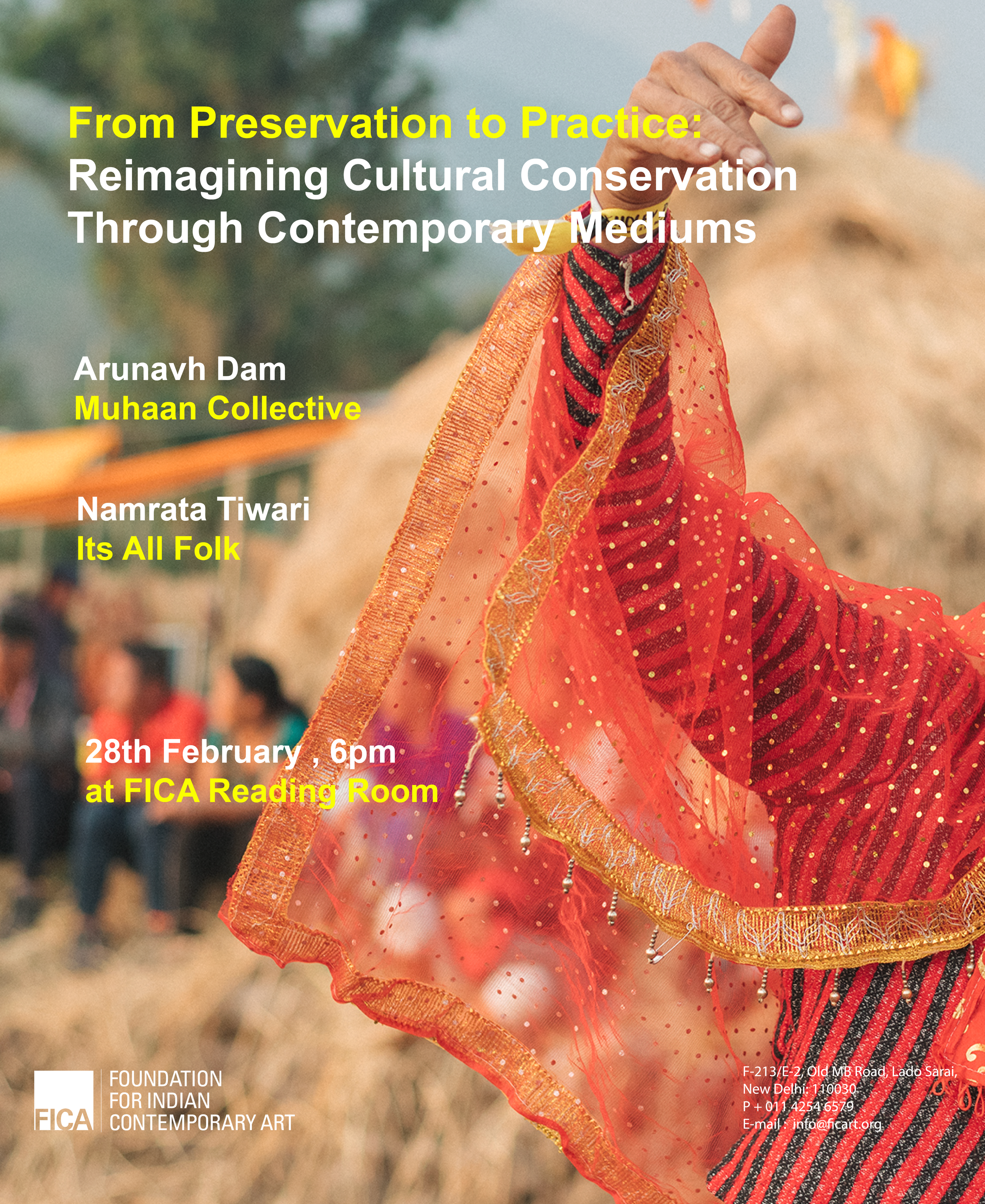
Saturday, 28 February 2026
6 PM
At the FICA Reading Room, New Delhi
Join us for a session of presentations and conversation with Arunavh and Namrata who will be exchanging notes around how cultural conservation can move beyond preservation into lived practice. Drawing from field-based work and expanded artistic approaches in the Eastern Himalayas, their presentations will explore how mediums such as festival design, food systems, craft traditions, documentation, pedagogy, and spatial interventions can sustain cultural landscapes as active and evolving processes. Social enterprises such as Muhaan and Its All Folk will share their practice-based work alongside other practitioners working at the intersection of art, design, and community contexts, reflecting on conservation as a participatory, practice-driven approach rather than static heritage.
About the facilitators:
Arunavh Dam is the co-founder of Muhaan (meaning “source” in Nepali), a social enterprise based in Kalimpong working at the intersection of community, culture, and conservation in the Eastern Himalayas. Rooted in the conservation of biocultural diversity, it collaborates with rural and Indigenous communities to develop community-based tourism, revive traditional knowledge, and strengthen local livelihoods through festivals, experiential journeys, and cultural documentation.
Namrata Tiwari is the Founder/Director of Its All Folk, a grassroots design and culture lab based in Arunachal Pradesh, working with living knowledge systems to design pathways where culture, land, and livelihoods evolve together. Across three villages and five interconnected programs, it focuses on resilient place-based livelihoods, intergenerational cultural transmission, stewardship-led market models for forest communities, and practice-based cultural continuity. Through long-term engagement with the Brokpa—the last semi-nomadic yak herders of the region—it is developing Norbu, a craft-conservation model rooted in community stewardship.