Library as a Lived Space / Reunion + Repertory + Rituals | Conceptualised by Kaur Chimuk
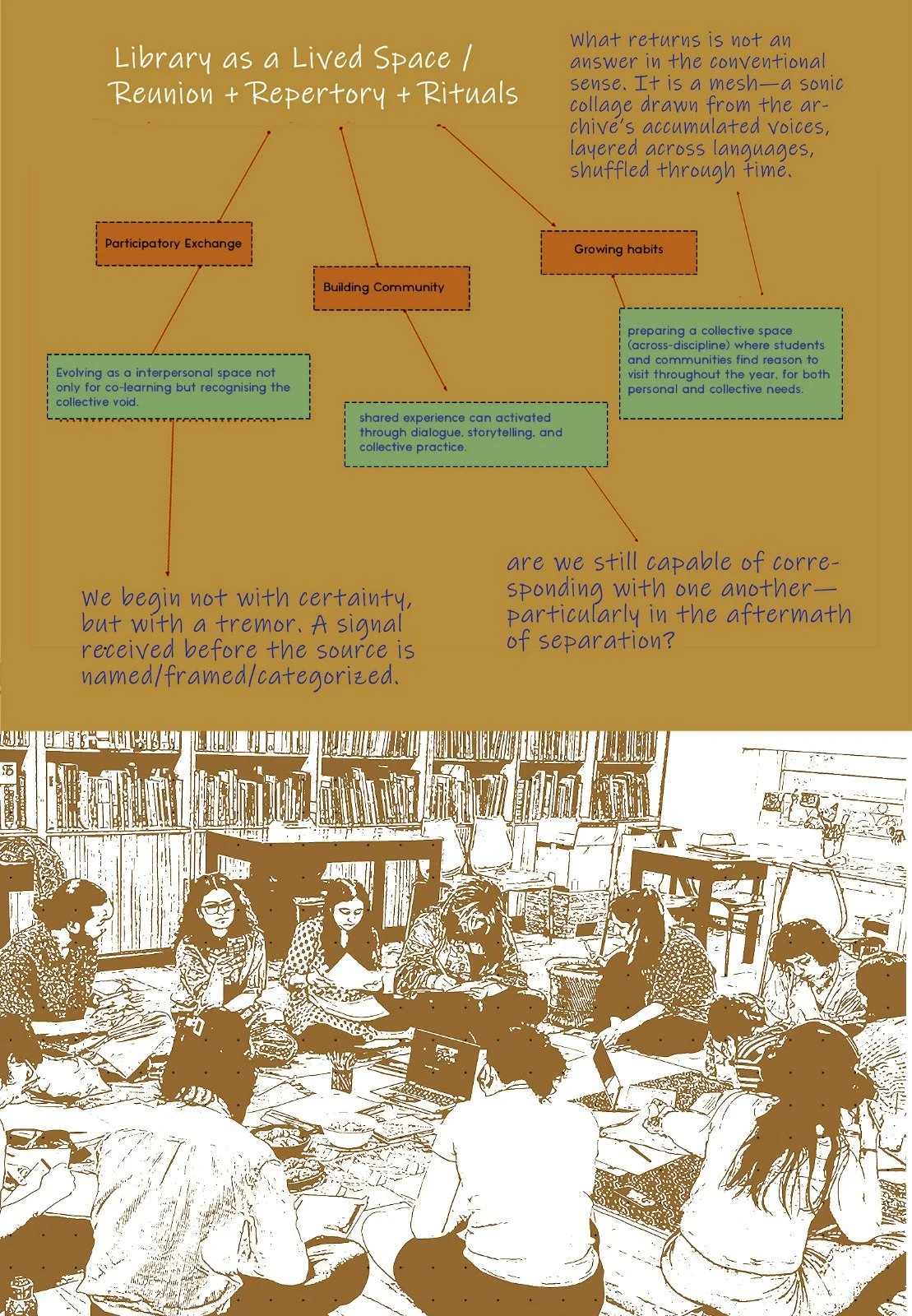
Library as a Lived Space is conceptualised as an observatory research methodology. The programme focuses on three interlinked areas: building community, participatory exchange, and creating confluence. Cohesive Correspondence will be the in-between bridges that will connect those three trans-axes. CC, as part of Library as a Lived Space, is envisioned as an evolving cohort that gathers around shared inquiries into habits, rituals, and associations connected to the library as a site-responsive space. Here, revisiting, re-engaging, and reflecting become inclusive and collective practices.
The programming is conceptualised into two halves for the cohort. The first half has just been summarised in a draft publication as a collective reflection, which is currently available for reading:
React or Otherwise / solidarite(s): Link
During the process, the cohort met with each other twice a month, alongside a running blog that serves as an elaborative space for reflection. We are currently slowly transitioning towards the second half, which will be more open—inviting participants from extended circles, including associates and temporary readers. This phase will also include seven reading sessions. During the second session, we will slowly materialise our experience into dialogue and debate around ‘belonging and alliance’ in relation to solidarities as a wider umbrella concern.
Timeline:
First sessions: April to July
Review: Early August
Second sessions: October to January
Address: At FICA Reading Room, F-213/E-2, Old MB Road, Lado Sarai, New Delhi: 110030, India
Prompts that we are curious to explore in the reading sessions :
As our attention shifts constantly from one moment to the next, how do these flickers—each carrying different degrees of urgency—shape our sensibilities, and in what ways do they contribute to the fragmentation of both individual consciousness and the wider collective?
In the context of expanded reading, how might we re-associate with loose memories—those not fully engaged because of their temporal and fleeting nature—and rework conceptual frameworks to imagine futures that are not repetitions of uncanny pasts?
“Umuntu ngumuntu ngabantu” — A person is a person through other people.
How can reading can move beyond an act of singularity and instead become a shared gesture—an ongoing process of re-prompting one another, and a quiet invitation toward collective re-engagement.
The reading material we are curious to discuss/share/exchange as an extend mode of exploring the prompts:
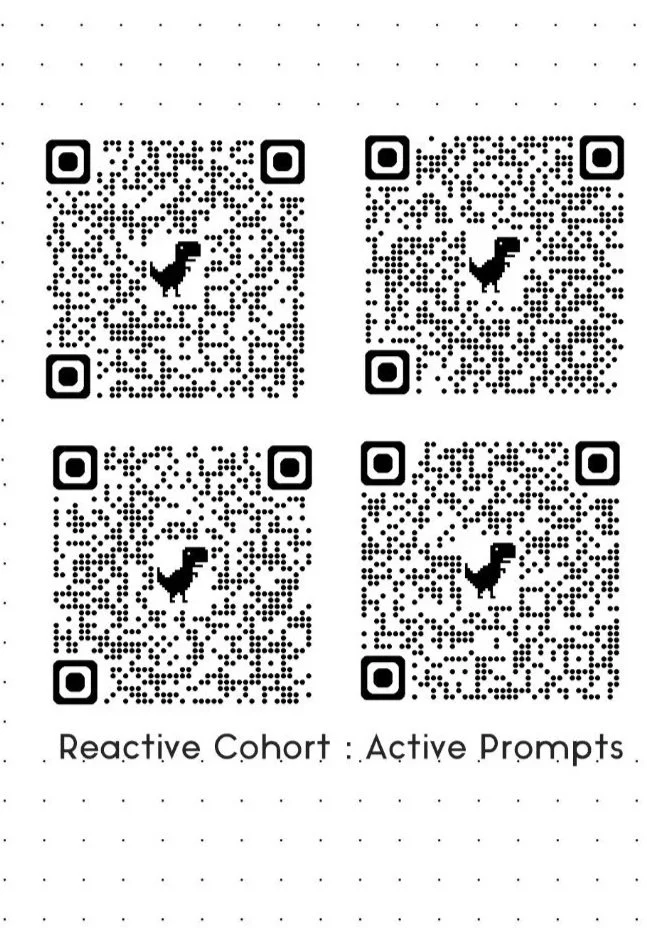
Extended reading:
Kill Joy Manifesto by Sara Ahmed
Myths of the Marble by Alex Klein (ICA) and Milena Hoegsberg (HOK)
Sarai Reader 05 : Bare Acts
Staying-with-the-trouble by Donna Harway
All Quiet in Vikaspuri by Sarnath Banerjee
S for Solidarity : The Jagori Alphabet Book
The Temporary Autonomous_Zone Ontological_Anarchy Poetic_Terrorism by Hakim Bay
Note: Each reading session/s will be framed by a thematic prompt that serves as a point of departure for mutual reading, co-listening, non-conforming critical dialogue, and collective unlearning. During the first few months, sessions will be facilitated by Kaur Chimuk along with invited co-moderators. In the second half of the programme, members of the cohort will gradually take the lead—designing and facilitating their own reading situations as a form of shared responsibility and evolving pedagogy.
Know more : Developed under Library as a Lived Space - a project in collaboration with Kaur Chimuk* and FICA as part of the FICA programme Reading / Commoning - we open this space for expanded dialogue—one that connects us through interpersonal needs that are multidirectional and interdisciplinary. The cohort weaves together theoretical inquiry, artistic practice, and conversations around contemporary glocal concerns, approaching reading as an experience that extends beyond institutional boundaries. Cohesive Correspondence will unfold in a hybrid format. Conceived as reading ceremonies which will take place at the FICA Reading Room twice a month, these sessions invite artists, writers, curators, scholars, and cultural practitioners who are interested in meeting through slow, attentive encounters. Together, we will map a cohesive space grounded in care and shared inquiry. Cohesive Correspondence will remain open to new members throughout the year. Like a hive, the cohort grows slowly and attentively. The emphasis is not on scale, but on depth—allowing associations to develop organically through curiosity, debate, and collective care rather than through fixed outcomes.
To read the Cohesive Correspondence blog, click here.
About the Facilitator :
Kaur Chimuk, Artist-Researcher is curious about subversive negotiations in the mode of artistic research and temporal representation. Based primarily in Southeast Asia, they work extensively across India and Bangladesh while maintaining an operational base in Sweden as part of the curatorial team with Meteor International. They are one of the founding members of South-East Asia’s micro-budget parallel international performance festival, KIPAF (Kolkata International Performance Art Festival), zmayet — an open-source cooperative between Bangladesh and India that supports self-publication, collective reading, and community library programs.
In recent years, Kaur managed to trace an interdependent cooperative that connects Mexico, India, and the UK like an inclusive tunnel for unlearning and mutual growth - this alliance is known as intrans aka intersectional network for transglocal solidarity. This network is dedicated to encouraging mutual resources that empower communities and individuals to embrace “re-existence.” know more ~ Kaurchimuk.weebly.com